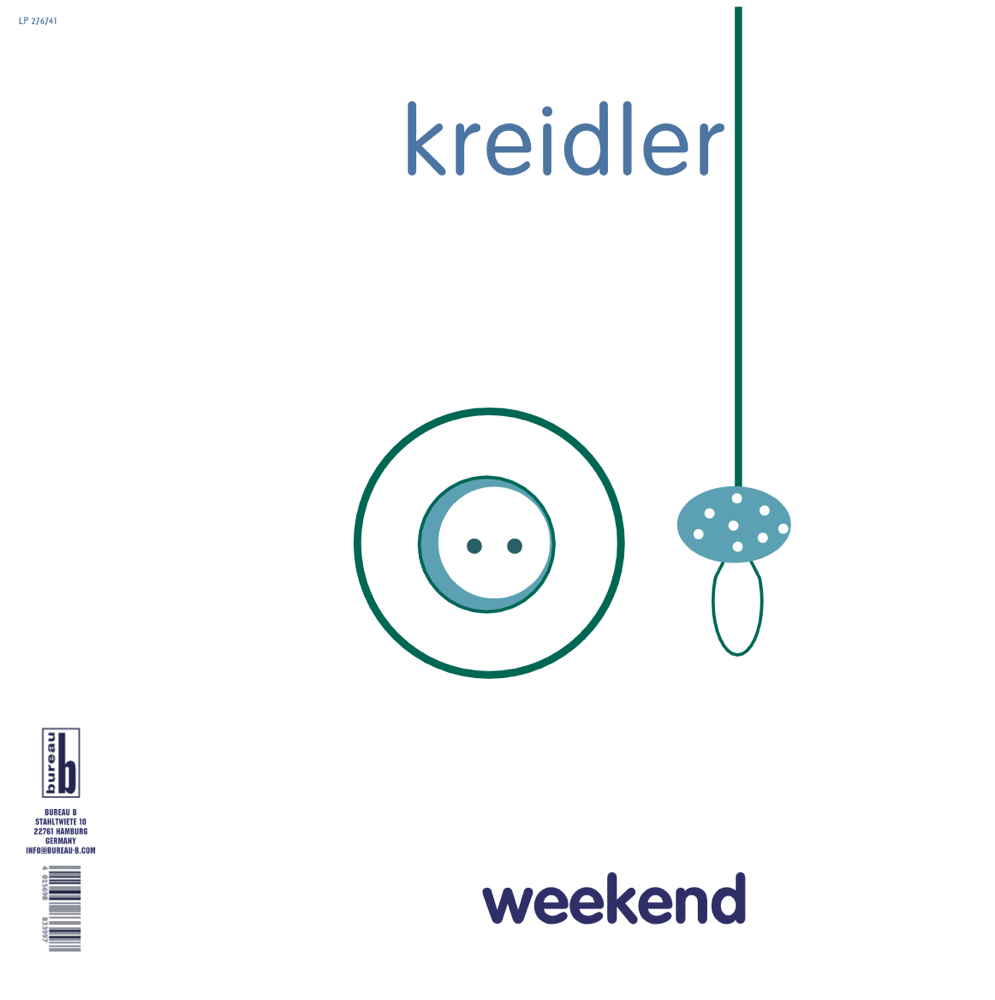
kreidler weekend (30 anniversary re-mastered edition)
|
|
|
|
|
|
(lp) lio | desto |
reflections | hillwood | telefon |||
traffic way | shaun | spat | la capital | sand colour classic |
|
aufnahme technik + pult bernd jestram milchhof + calyx studio berlin april--mai 1996 mastering + vinyl cut mike grinser - manmade mastering juni 2026
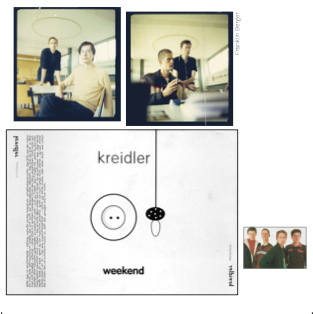
musik titel + produktion klein reihse schneider weinrich originally released 1996 on kiff sm - kiff 004 published by freibank musikverlage audio supervision alex paulick - spatialtone 2026 reissue production daniel jahn + gunther buskies
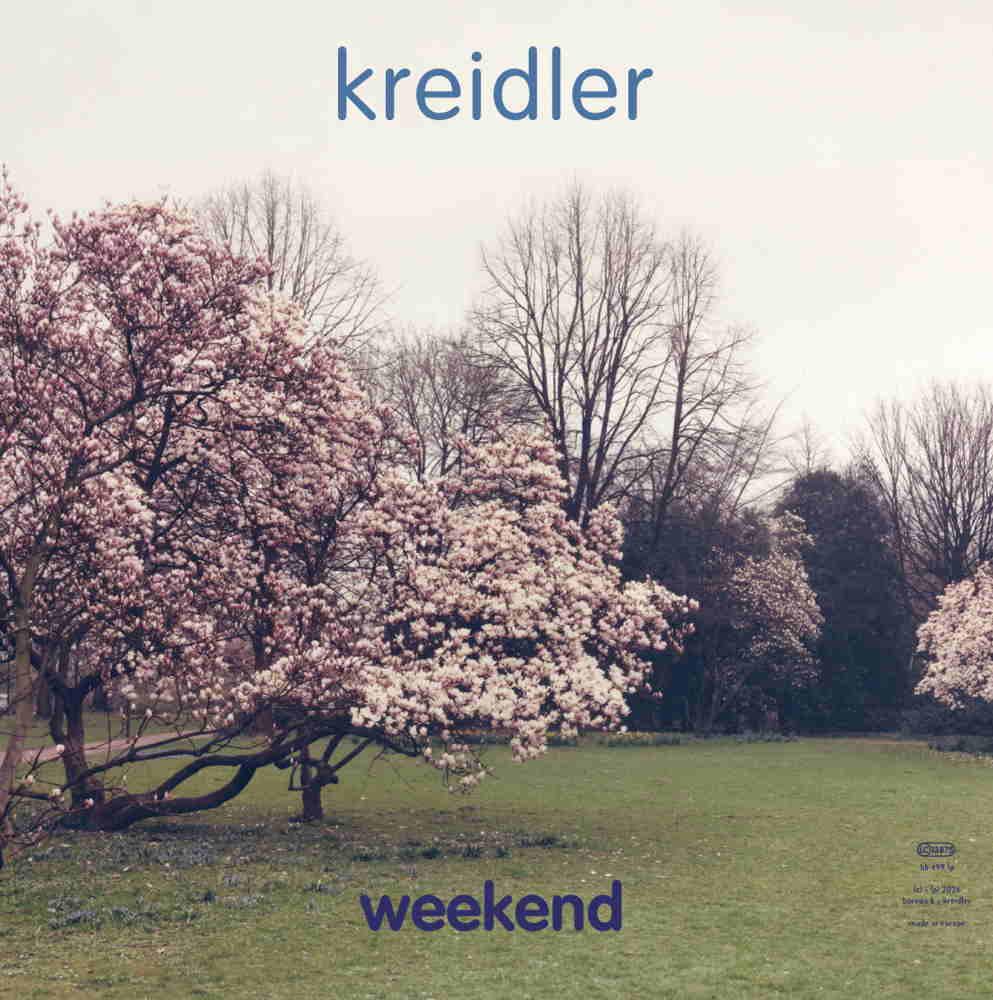
cover reihse – foto schneider many thanks to seda mimaroğlu ronald dick jutta bächner and all the others involved bureau-b.com - ikreidler.de
all rights reserved - unauthorised copying reproduction hiring lending public performance and broadcast prohibited (c) & (p) 2026 bureau b & kreidler bb 499 |
|
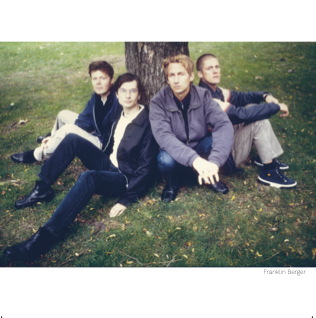
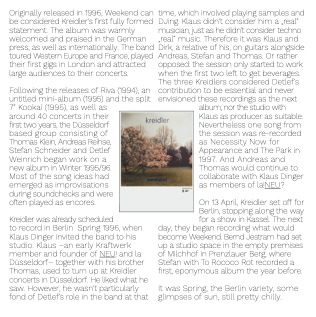
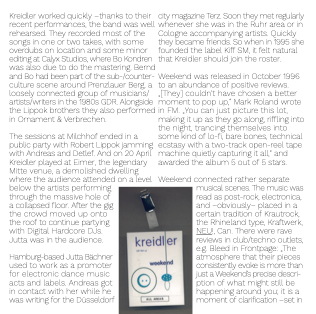
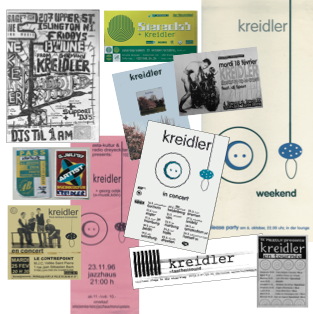
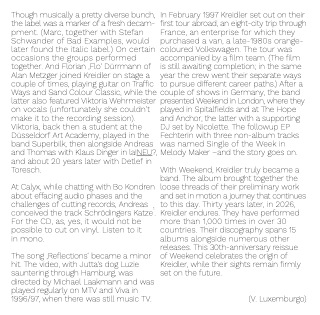
kreidler weekend Originally released 30 years ago, Weekend can be considered Kreidler‘s first fully formed statement. With Weekend, Kreidler truly became a band. The album brought together the loose threads of their preliminary work and set in motion a journey that continues to this day. In 1996, Weekend was warmly welcomed and praised in the German press, as well as internationally. The band had shows in Western Europe, toured France, played their first gigs in London and attracted large audiences to their concerts. The song Reflections became a minor hit and went on rotation on MTV and Viva. The Düsseldorf based group consisting of Thomas Klein, Andreas Reihse, Stefan Schneider and Detlef Weinrich began work on the album in Winter 1995/96. Most of the song ideas had emerged as improvisations during concert soundchecks and were often played as encores. In April, Kreidler set off to Berlin to record what would become Weekend. Bernd Jestram had set up a studio space in the empty premises of Milchhof in Prenzlauer Berg. Kreidler worked quickly —thanks to their recent performances, the band was well rehearsed. They recorded most of the songs in one or two takes, with some overdubs on location and some minor editing at Calyx Studios, where Bo Kondren was also due to do the mastering. Bernd and Bo had been part of the sub-/counter-culture scene around Prenzlauer Berg, a loosely connected group of musicians/artists/writers in the 1980s GDR. Alongside the Lippok brothers they also performed in Ornament & Verbrechen. The sessions at Milchhof ended in a public party with Robert Lippok jamming with Andreas and Detlef. And on 20 April Kreidler played at Eimer, the legendary Mitte venue, a demolished dwelling where the audience attended on a level below the artists performing through the massive hole of a collapsed floor. After the gig the crowd moved up onto the roof to continue partying with Digital Hardcore DJs. Jutta was in the audience. Jutta Bächner used to work as a promoter for electronic dance music acts and labels. Andreas got in contact with her while he was writing for Düsseldorf city magazine Terz. Soon they met regularly whenever she was in the Ruhr area or in Cologne accompanying artists. Quickly they became friends. So when in 1995 she founded the label Kiff SM, it felt natural that Kreidler should join the roster. Weekend was released in October 1996 to an abundance of positive reviews. "[They] couldn‘t have chosen a better moment to pop up," Mark Roland wrote in FM. "You can just picture this lot, making it up as they go along, riffling into the night, trancing themselves into some kind of lo-fi, bare bones, technical ecstasy with a two-track open-reel tape machine quietly capturing it all," and awarded the album 5 out of 5 stars. |
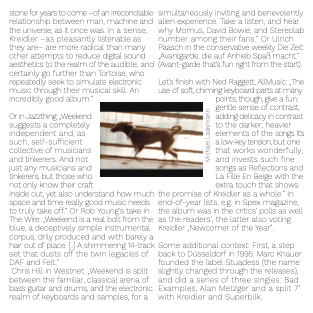
Weekend connected rather separate musical scenes. The music was read as post-rock, electronica, and —obviously— placed in a certain tradition of Krautrock, the Rhineland type, Kraftwerk, NEU!, Can. Or Rob Young‘s take in The Wire: "Weekend is a real bolt from the blue, a deceptively simple instrumental corpus, drily produced and with barely a hair out of place. [..] A shimmering 14-track set that dusts off the twin legacies of DAF and Felt." Chris Hill in Westnet: "Weekend is split between the familiar, classical arena of bass guitar and drums, and the electronic realm of keyboards and samples, for a simultaneously inviting and benevolently alien experience. Take a listen, and hear why Momus, David Bowie, and Stereolab number among their fans." Or Ulrich Paasch in the conservative weekly Die Zeit: "Avantgarde, die auf Anhieb Spaß macht." (Avant-garde that‘s fun right from the start). Let‘s finish with Ned Raggett, AllMusic: "The use of soft, chiming keyboard parts at many points, though, give a fun, gentle sense of contrast, adding delicacy in contrast to the darker, heavier elements of the songs. It‘s a low-key tension, but one that works wonderfully, and invests such fine songs as Reflections and La Fille En Beige with the extra touch that shows the promise of Kreidler as a whole." In end-of-year lists, e.g. in Spex magazine, the album was in the critics‘ polls as well as the readers‘, the latter also voting Kreidler "Newcomer of the Year". Thirty years later, in 2026, Kreidler endures. They have performed more than 1,000 times in over 30 countries. Their discography spans 20 albums alongside numerous other releases. This 30th-anniversary reissue of Weekend celebrates the origin of Kreidler, while their sights remain firmly set on the future. Info Sheet (pdf) english ⁝ deutsch |